
Japanese strawberries in India: what they are, and where to actually buy them
Search “Japanese strawberry” and you get two pictures. One is a single perfumed berry in a Tokyo department-store box, sold for the price of a meal. The other is a viral auction headline — a tray of strawberries going for thousands of dollars. Both are real. Neither is how you put Japanese strawberries on an Indian menu.
There is a third option, and it is the one most people searching for “Japanese strawberry in India” are actually looking for: the same Japanese cultivars, grown here in India, on a domestic cold chain — no airfreight, no gift-counter markup. That is what ICHIGO is.
What makes a strawberry “Japanese”
A “Japanese strawberry” is not a place — it’s genetics and discipline. Japan spent decades breeding strawberry varieties for one thing the rest of the world traded away: flavour on the plate. High sugar, real aroma, dense flesh that takes a clean knife, and a calyx that stays green and upright.
ICHIGO grows two of those cultivars — Miyoshi & Co’s Berry Pop F1 series, the first private F1-seed strawberries developed in Japan:
- SAKURA — bred to lead with sweetness and perfume. The berry you reach for when the strawberry is the dish.
- HARUHI — bred for a stable sugar–acid balance and year-round consistency. The dependable line that plates the same in June as it did in January.
Because Berry Pop is delivered as seed, not transplant, these Japanese varieties can be grown legally and locally — in countries that don’t permit importing live strawberry plants from Japan. That single fact is what makes “Japanese strawberries, grown in India” possible at all.
”Grown in India” — the part that matters
Most strawberries in India come from a short list of workhorse varieties — Winter Dawn, Camarosa, Nabila, Sweet Charlie, Chandler — bred for yield, size and shelf life so they survive the trip to a mandi. Excellent berries for what they’re for. They simply weren’t selected to be the hero of a plated dessert. (We compare them head to head in our guide to Japanese strawberry varieties for Indian kitchens.)
ICHIGO is the opposite trade-off. Japanese seed, planted in Indian fields under Japanese agricultural supervision, cultivated in Maharashtra by M2labo Bharat — including Vertigrow vertical-hydroponic polyhouse cultivation run with our partner HiMedia Laboratories. A punnet carrying the ICHIGO mark has been:
- Grown from licensed SAKURA or HARUHI seed under the ICHIGO cultivation protocol
- Picked inside the agreed maturity window — not over-ripe, not under-ripe
- Pre-cooled within two hours of harvest at a farm-cluster cold dock
- Single-layer packed, calyx-up, in the branded black window box
- Lot-traced back to a named plot and pick date
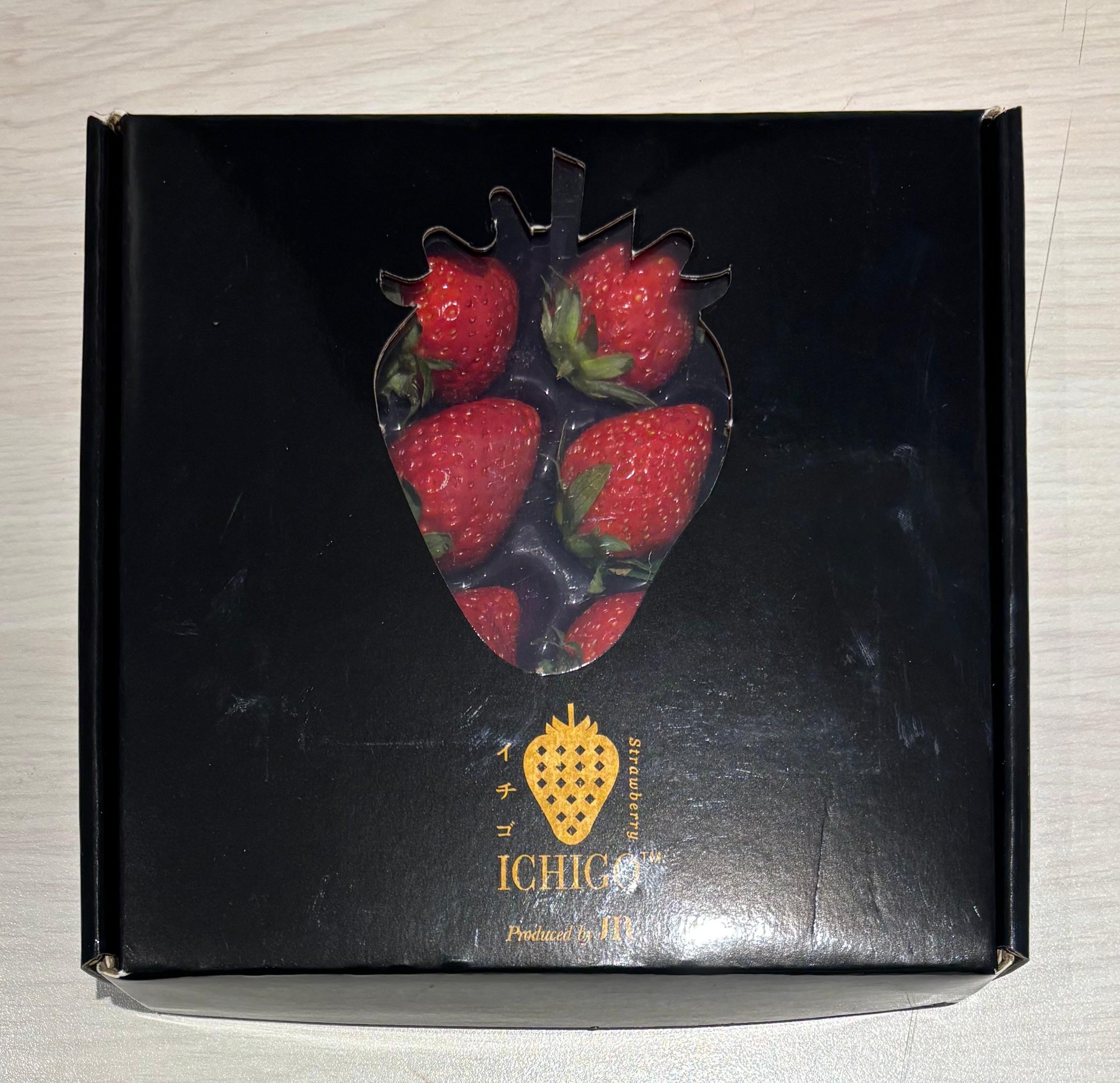
The point of growing in India isn’t to cut a corner. It’s that airfreighting fruit from Japan is wasteful, expensive and unnecessary when the right seed and the right handling produce the same berry in the right Indian altitude bands — at a price a working kitchen can reorder every week.
Are they expensive?
Imported Japanese strawberries in India carry an import-and-airfreight premium that only a gift counter can justify. ICHIGO is deliberately not that. SAKURA and HARUHI are positioned for the kitchen — pastry chefs, hotel F&B, dessert-first restaurants — at a price built around weekly reorders, not one-off luxury. For how premium berries are actually priced against the mandi rate, see our strawberry wholesale price guide for India.
Where to buy Japanese strawberries in India
If you’re a restaurant, hotel, cloud kitchen, bakery or premium retailer, you can source SAKURA and HARUHI directly from ICHIGO through Vegibus India’s shared cold-chain routes. The fastest way to decide is to taste them next to the berry you use now.
→ Ask for a SAKURA + HARUHI sample box and we’ll send both to compare. Start on our contact page.
- 📞 Ishita Shroff — +91 98314 79900
- 📞 Mitesh Furia — +91 98207 73767
- ✉️ contact-bharat@m2-labo.jp
ICHIGO® — Japanese strawberry cultivars (Miyoshi Berry Pop F1 SAKURA & HARUHI), grown in India. Produced by M2labo (M2labo Bharat Pvt. Ltd.).
Japanese strawberry quality, grown in India's hills.
Notes from the farm, the cold chain and the chefs putting Indian strawberries on the world's tables.