
How to spot a premium strawberry — the chef's 5-point check
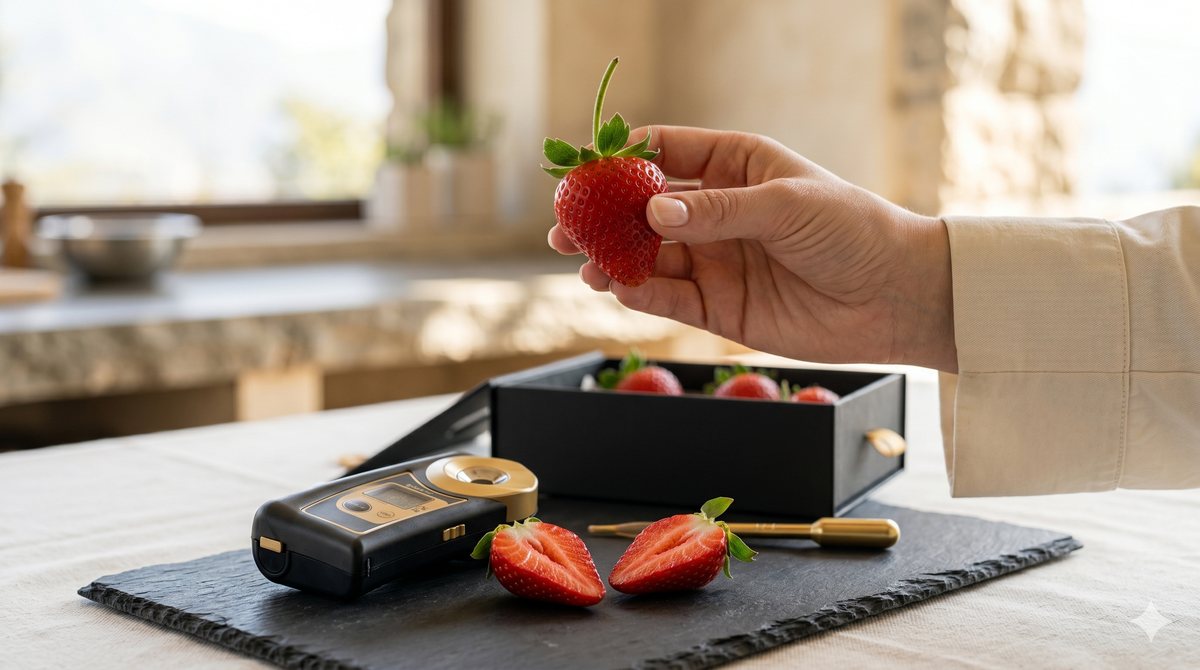
Two punnets can look identical in the crate and cost the same — and only one of them plates. The difference shows up later: in a dessert that tastes flat, a berry that weeps when you halve it, a tray you quietly move to the staff fridge. A premium strawberry is a decision you make at the receiving table, in about thirty seconds, before the crate ever reaches the pass.
Here are the five things a chef checks, in order. None of them needs a lab — four need only your eyes, hands and nose, and the fifth needs a tool that costs less than one bad delivery.
1 — The calyx
The calyx is the green crown. It is the first thing to age and the first thing to give a berry away. On a fresh strawberry it is green, perky and standing up. On a tired one it wilts, curls and browns at the tips. A berry can still look red and sound fine while its calyx is already telling you it was picked too long ago — or handled warm. This is also why it matters how a berry is packed: calyx-up, single-layer, so the crown is protected and inspectable the moment the box is opened.
2 — The colour
You want an even, deep red all the way to the shoulders (the area around the calyx) and to the tip. Watch for two faults:
- White or pale shoulders — the berry was picked under-ripe. Strawberries do not keep sweetening meaningfully after harvest, so an under-ripe berry stays under-ripe on your plate.
- Dull, dark, almost wine-coloured fruit — over-ripe, on its way out. Beautiful for an hour, mush by service.
Premium fruit is glossy, not matte, and the colour is consistent across the punnet — not a lottery of ripe and unripe in the same box.
3 — The firmness
Pick one up. A good berry is firm with a slight give — like the pad of your thumb. Rock-hard means unripe. Soft, yielding or already weeping means over-ripe or bruised, and it will not survive being cut. Dense flesh is what lets a berry take a clean knife and hold a halved face on the plate without bleeding out. If the punnet feels wet at the bottom or the fruit is sticking together, that’s juice from broken berries — a whole crate’s clock is ticking faster.
4 — The Brix
Brix is the measure of sweetness — dissolved sugar, read on a refractometer, a pocket tool every serious pastry section should own. Crush a drop of juice onto the glass, read the number. Dessert-grade strawberries should read consistently high, and not swing from crate to crate. For reference: a typical supermarket strawberry sits around 7–9 °Brix; full-ripe ICHIGO SAKURA averages 11–12.3 °Brix — on par with ripe pineapple or pomegranate. Brix without acid tastes cloying, so read it alongside point 5 — sweetness and aroma together are what “ripe” actually means.
5 — The smell
A ripe strawberry announces itself. Lift the punnet to your nose: you should get a clear, sweet, unmistakably-strawberry perfume before you’ve even tasted one. Little or no smell is the single most reliable sign that a berry was bred or picked for shelf life and transport, not for flavour. Aroma is the part a photograph can’t fake and a long cold haul can’t add back.
Make it a habit
Run the five every time fruit arrives — calyx, colour, firmness, Brix, smell — and reject before you sign, not after you plate. It takes thirty seconds and it is the cheapest quality control in your kitchen. The reason a lot-traced, Brix-verified, calyx-up box matters is that it’s built to pass this exact check on arrival — every crate, every week, not just on the day you happened to taste it.
→ Want to run the 5-point check against ICHIGO? Ask for a SAKURA + HARUHI sample box and test it next to your current berry. Start on our contact page.
- 📞 Ishita Shroff — +91 98314 79900
- 📞 Mitesh Furia — +91 98207 73767
- ✉️ contact-bharat@m2-labo.jp
ICHIGO® — Japanese strawberry cultivars (Miyoshi Berry Pop F1 SAKURA & HARUHI), grown in India. Produced by M2labo (M2labo Bharat Pvt. Ltd.).
Japanese strawberry quality, grown in India's hills.
Home delivery and business quantities, cold-chain across Mumbai, Pune, Bengaluru, Chennai and Hyderabad.