
Where ICHIGO actually grows: our fields across India
For a chef, a premium berry is a provenance story before it’s a flavour. Where did it grow, who grew it, and can you get the same thing next week? “Imported” isn’t an answer — it’s a price tag and a question mark.
ICHIGO’s answer is a map. We grow Japanese cultivars on real, named ground in India, under Japanese agricultural supervision, on soil we build ourselves. Here’s where, and why each place earns its spot.
The cultivars travel; the supervision travels with them
Across every site we plant the same two Japanese cultivars — Miyoshi & Co’s Berry Pop F1 varieties, SAKURA (bred for sweetness and aroma) and HARUHI (bred for a stable sugar–acid balance and year-round consistency). India’s open-field workhorses — Winter Dawn, Camarosa, Nabila — were bred for yield and transport. SAKURA and HARUHI were bred for the plate.
Planting the same genetics on different ground is deliberate. It means a Kaprada berry and an Ambegaon berry are the same cultivar grown two ways — so we learn which climate does what, and a buyer gets one consistent product, not a lottery by region.
Kaprada, Gujarat — open field and greenhouse, side by side
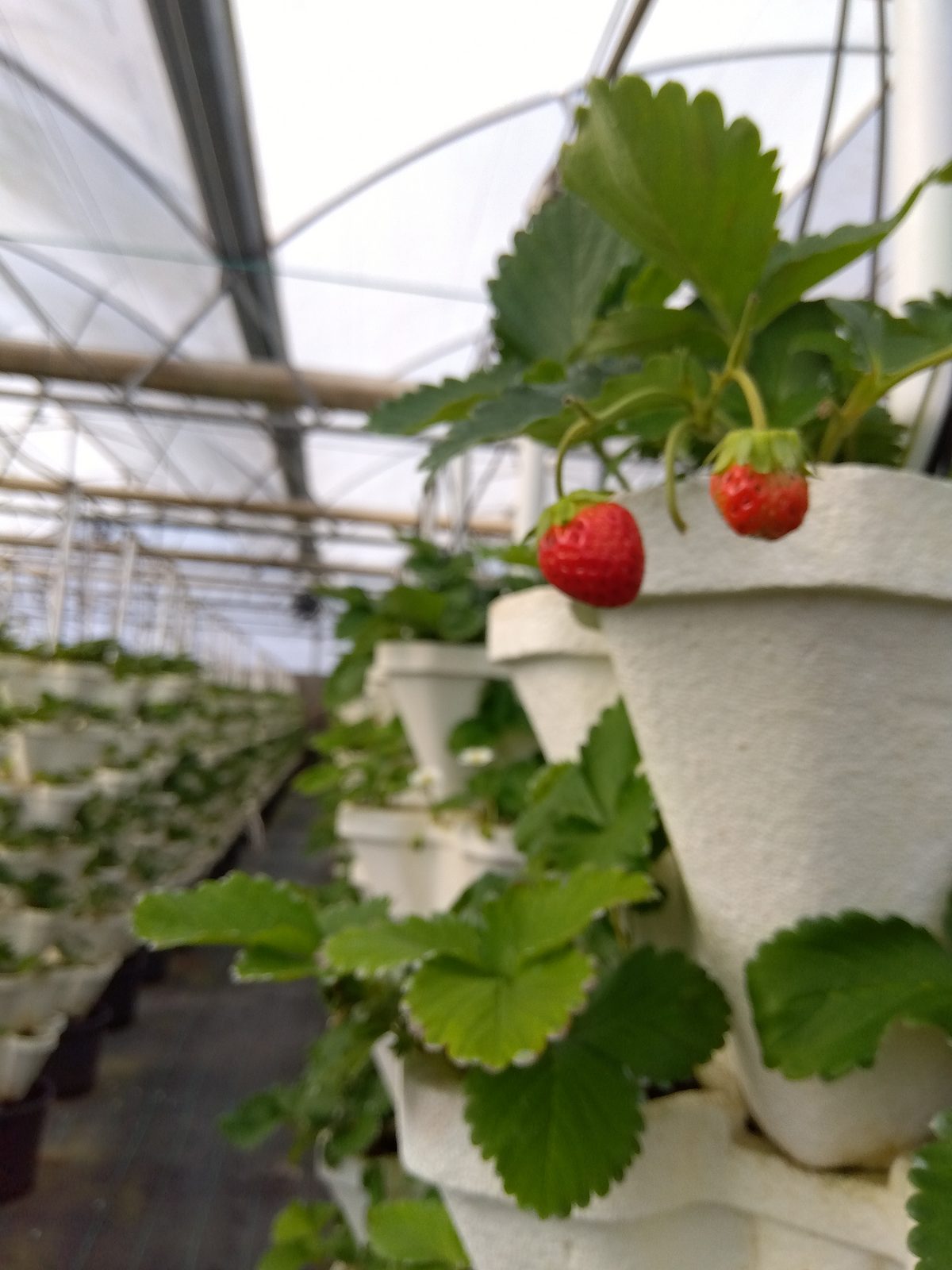
In Kaprada (Valsad district, southern Gujarat) we run open-field beds and a greenhouse on the same site. That pairing is the point: the open field tells us what the cultivar does in real Gujarat conditions, and the protected house tells us what it does when we hold the climate steady. Same seed, two roofs, one comparison.
This is also where the Japanese method is most visible. The growing equipment itself was shipped from Japan — packed in Shizuoka, in by sea through Nhava Sheva — so the cultivation system in Kaprada is the Japanese one, not a local approximation of it.
Ambegaon, near Pune — open field in the Bhimashankar belt
In Ambegaon (Pune district, Maharashtra), up in the Bhimashankar hills, we grow in open field. It’s cooler, higher country than the Gujarat coast — a different stress profile for the same plant, and a region with a real strawberry culture to build alongside.
Between Kaprada and Ambegaon we get what a single farm never can: the same cultivar, the same supervision, two genuinely different climates. That’s how you build a supply that doesn’t vanish when one region has a bad month.
The soil is built, not just planted
None of this works on tired ground. Under every ICHIGO field is the same discipline we run under the Tsuzuku banner — BLOF, Bio Logical Farming: feed the soil, not just the plant. Crop residue is returned and matured into the soil (on the order of a tonne of rice straw for every thousand square metres), the beds are solar-conditioned before planting, and the soil is tested before conditioning, after conditioning, and after harvest — so we know what the ground actually did, not what we hoped.
Living soil is what lets the cultivar express itself: the sweetness, the firm calyx, the even colour are all downstream of soil that’s alive.
Why a map beats a label
“Imported Japanese strawberries” is a label. Kaprada and Ambegaon, SAKURA and HARUHI, living soil and Japanese supervision is a map — and a map is something a kitchen can plan a menu around. As routes open toward Bengaluru and further north, the map grows; the method doesn’t change.
Behind it is M2labo Bharat Pvt. Ltd., the India arm of Japan’s M2Labo, backed by Suzuki — so the field you sourced from this season is still there next season.
Source from a field you can name
Tell us your city, the dishes you’re building, and a rough weekly volume, and we’ll come back with grades, pack sizes, crate prices and the nearest delivery schedule.
→ Request a sample box and current crate prices on our contact page.
- 📞 Ishita Shroff — +91 98314 79900
- 📞 Mitesh Furia — +91 98207 73767
- ✉️ contact-bharat@m2-labo.jp
ICHIGO™ — Japanese strawberry cultivars, grown in India. Produced by M2Labo (M2labo Bharat Pvt. Ltd.).
Japanese strawberry quality, grown in India's hills.
Notes from the farm, the cold chain and the chefs putting Indian strawberries on the world's tables.