
Off the ground: inside ICHIGO's Vertigrow polyhouse
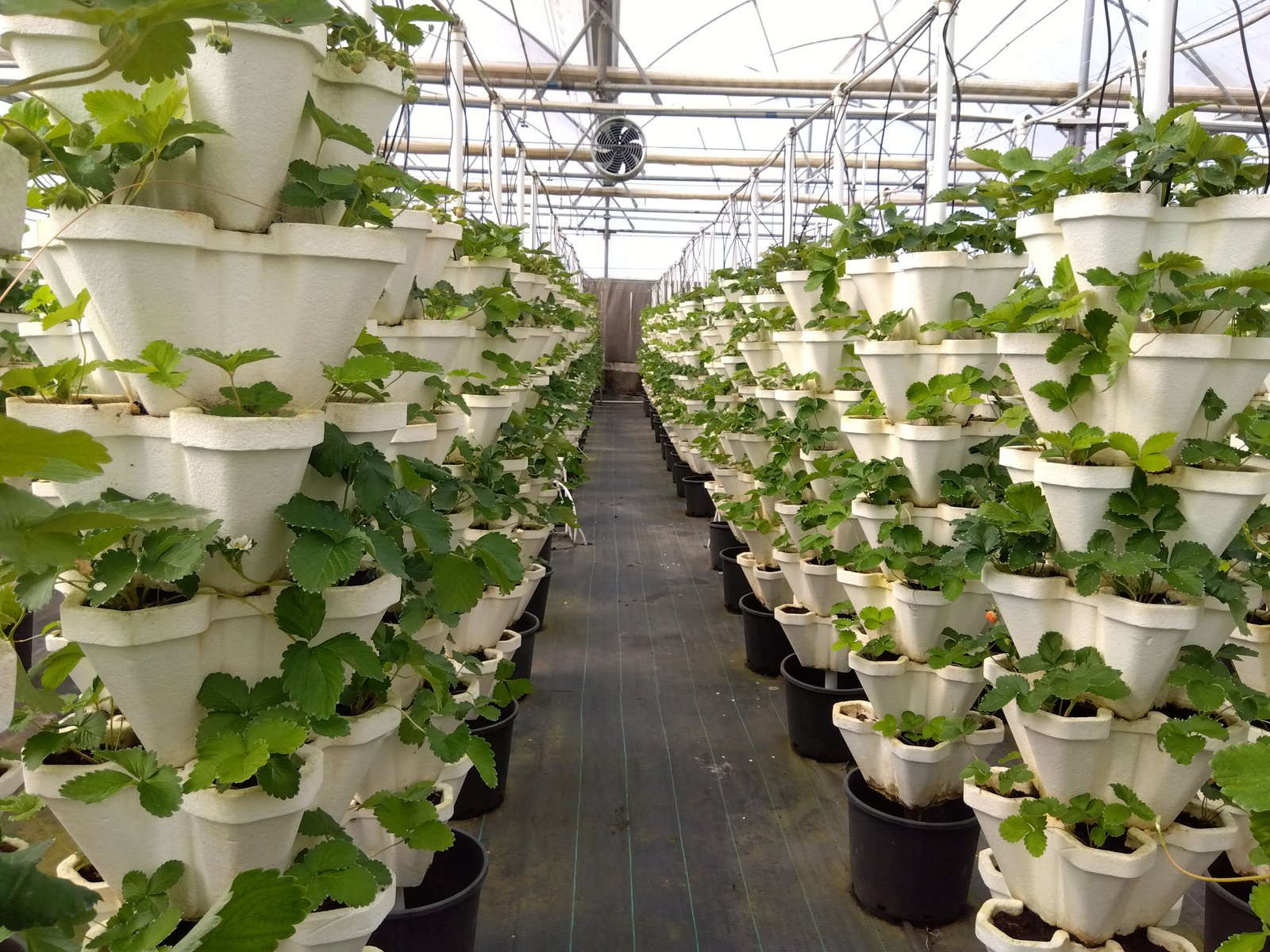
Most strawberries grown in India sit in open soil, low to the ground, exposed to the monsoon, the dust and whatever the weather does that week. The plants in the photograph above are doing none of those things. They are growing off the ground, under cover, in stacked towers inside a polyhouse near Pune — a trial we run with HiMedia Laboratories and call Vertigrow.
This piece is about why a premium strawberry increasingly gets grown this way, what the evidence actually shows it buys, and — because this is a field thick with marketing — where the hype runs ahead of the science. We’ll be honest about both.
What a roof buys you
The first decision is simply to put a cover over the crop. “Protected cultivation” — polytunnels, polyhouses, greenhouses — is now the default for serious strawberry growing, and the evidence is solid. A 2025 peer-reviewed review pooling 133 experiments found that tunnel-grown strawberries yield roughly 30–34% more than open-field plants, at similar fruit weight. In absolute terms, the figures it cites run from about 19 tonnes per hectare in the open field to 33–48 tonnes under cover.
But the yield number is almost the least of it. The real reasons to put a roof on a strawberry crop are protection and timing:
- Weather and disease. A cover keeps rain off the fruit, frost off the flowers and dust off the leaves — and dramatically cuts the fruit rots (like botrytis) that destroy open-field berries after a wet spell.
- Season. Cover lets you harvest earlier and longer. In Florida, high tunnels raised early-season yield by up to 54%; in high-altitude Indian trials, growing under cover advanced the harvest by roughly a month.
We should be equally clear about the limit, because the same review is: a roof is not unconditionally good. Under low light it can cost yield; a badly ventilated tunnel cooks the plants and breeds powdery mildew. A polyhouse is a tool that rewards management, not a magic box. Ventilation — that fan you can see at the end of the row above — is not an afterthought.
Why we lift the plants off the ground
The second decision is to stop growing in the soil at all. In a soilless “table-top” system, plants grow in troughs or bags of coir (coconut-fibre) substrate, raised on trellises to about waist height. Walk into the Vertigrow house and the fruit hangs at eye and hand level, not at your ankles.
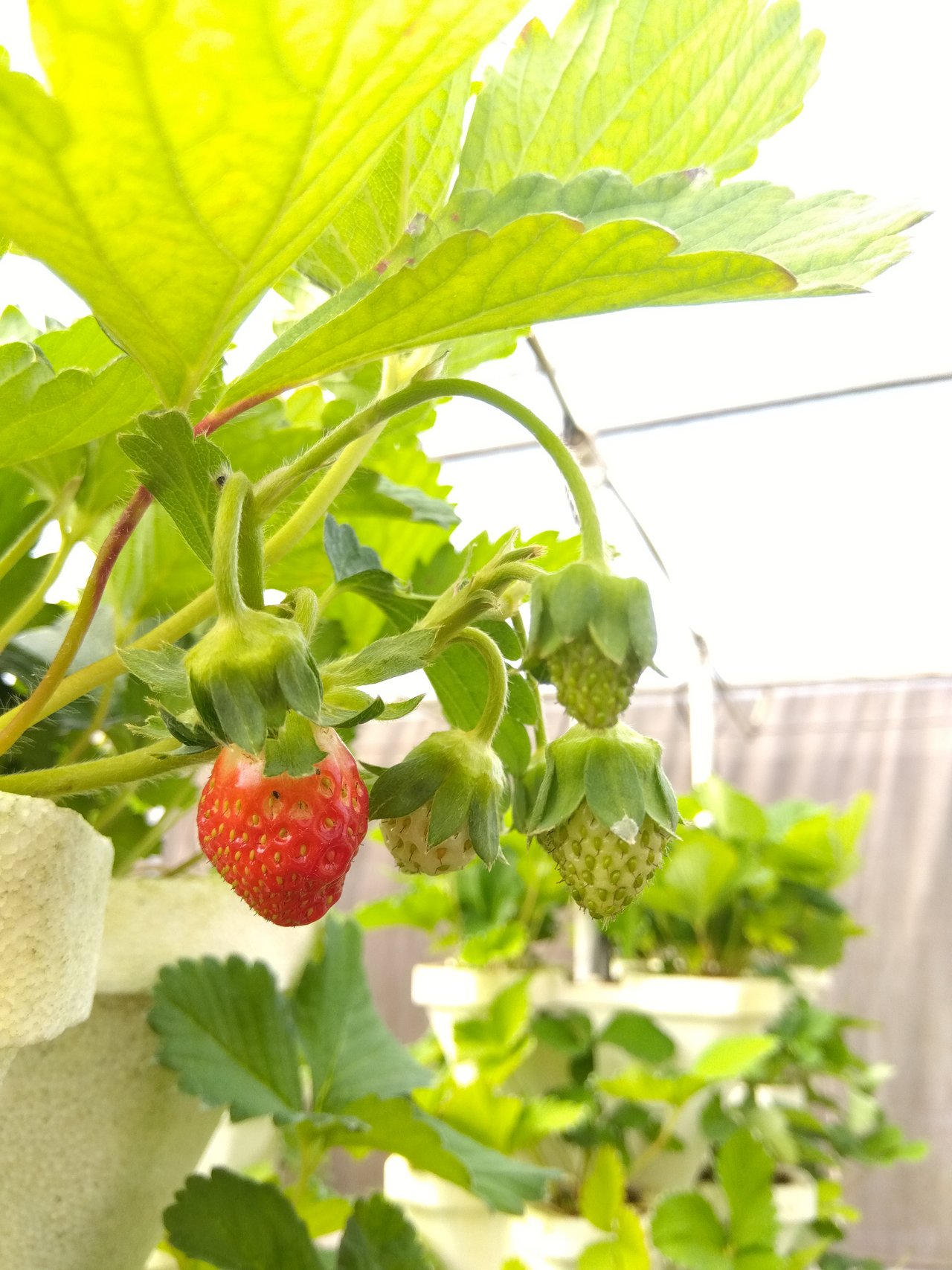
Lifting the plants does several things at once. Pickers work standing up, not stooped, which is faster and kinder on the body — industry figures put the labour saving around 20–25%. Air moves freely around every berry, so the fruit dries fast and rots less. And because the plants sit in containers, you can pack them more densely than in a field.
Water is the part that matters most in India. Under a polyhouse, drip irrigation plus mulch transforms how efficiently a strawberry uses water. One multi-season Indian polyhouse trial reached around 31 tonnes per hectare while using a fraction of the water of a surface-irrigated, unmulched crop — drip alone saved roughly half the irrigation water. Add sensor-scheduled fertigation — watering by what the substrate actually needs rather than a fixed timer — and trials have cut fertiliser use by about 40% with no loss of yield. For a crop grown in a water-stressed country, that is not a luxury feature; it is the whole point.
The honest part: vertical farming is not magic
Now the towers — the most photogenic thing in the house, and the part that needs the most honesty.
Stacking plants vertically, and the glowing LED racks we use to raise young plants, look like the future. They are genuinely useful: vertical growing multiplies the plants you can fit under one roof, and LED nurseries let us start clean, uniform seedlings independent of the season.
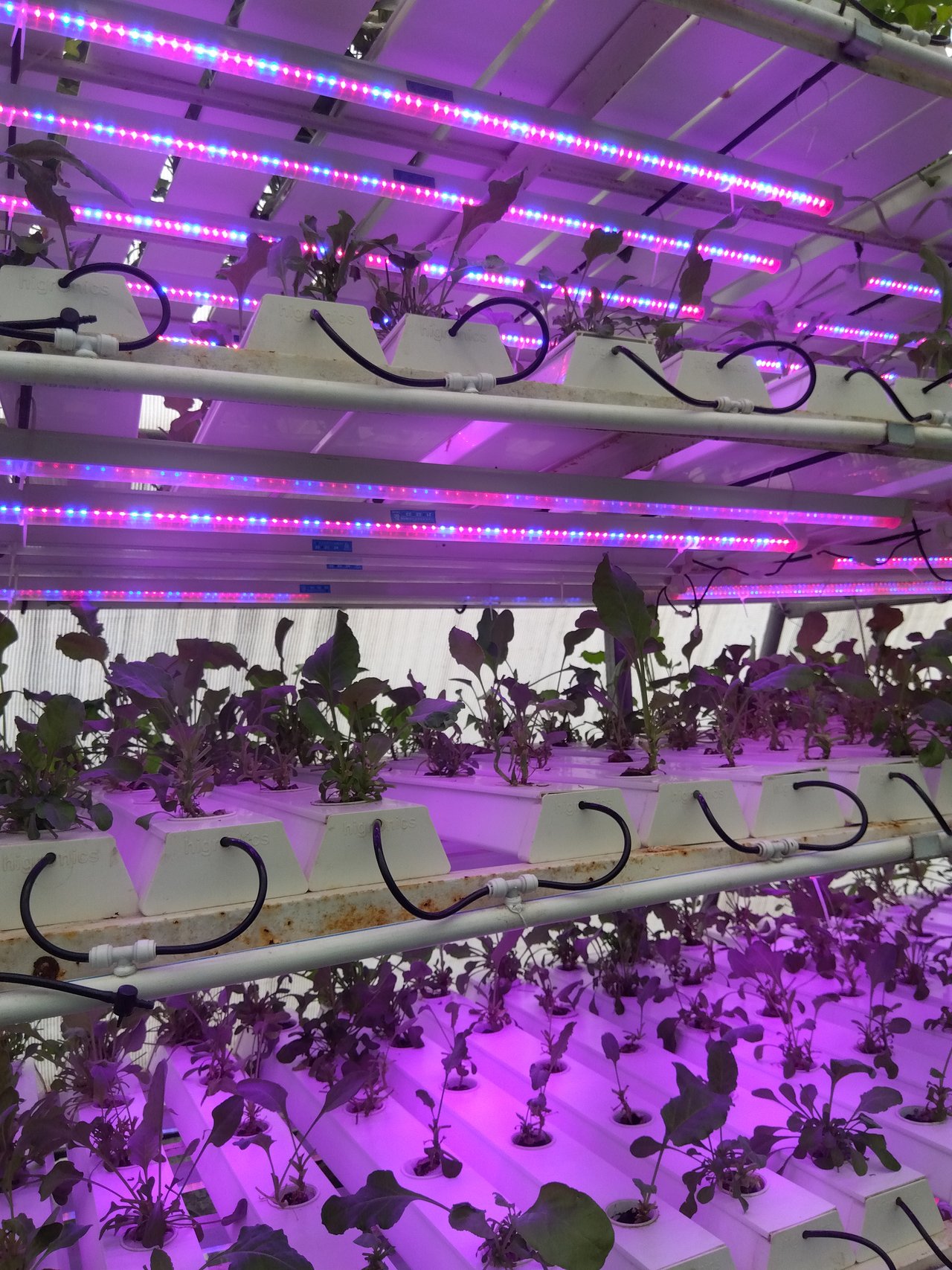
But here is what the marketing rarely says: for strawberries, vertical and water-culture systems are not automatically better. A 2025 controlled-environment trial compared growing methods head-to-head and found that plain substrate (coir) culture beat the water-culture and vertical-tower systems — by a wide margin on both yield and water-use efficiency. And the wider vertical-farming industry has been a graveyard of expensive failures: one of the most heavily funded names, Plenty, filed for bankruptcy in 2025 after raising close to a billion dollars. The companies that survive tend to do so by growing the right crop at a genuine premium, not by stacking everything as high as possible.
That is exactly why Vertigrow is a trial, not a billboard. We grow towers, gutters and LED nurseries side by side precisely to learn which combination actually produces the best SAKURA and HARUHI berries in Indian conditions — and to throw out the parts that only look good in photographs. Honest answers come from comparison, not from faith in a single clever system.
Japanese discipline, Indian polyhouse
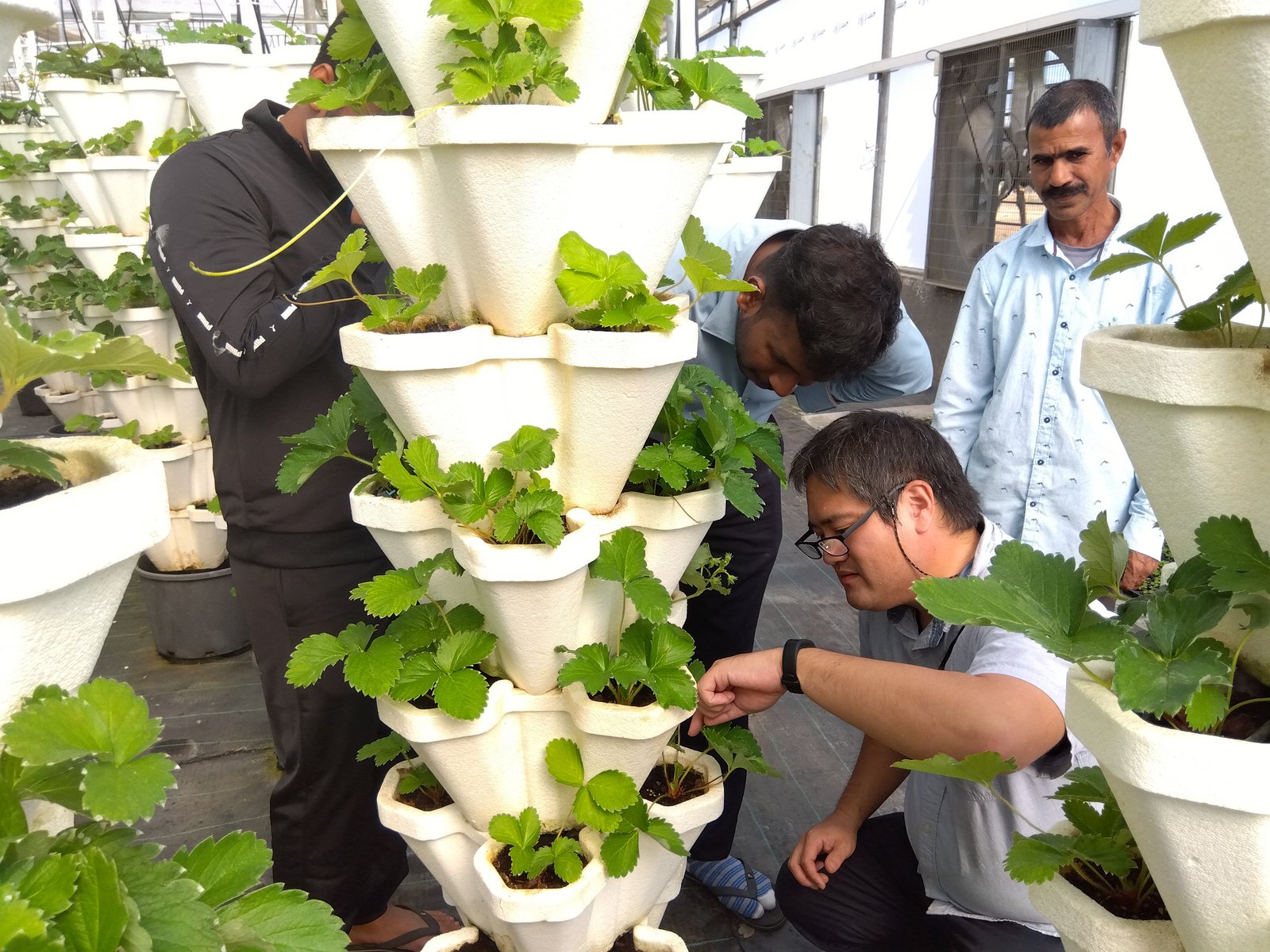
Protected cultivation is growing fast in India, and the government actively supports it — the national horticulture scheme (MIDH) offers credit-linked subsidies of around 50% on greenhouse and polyhouse structures. But most of the published Indian research comes from high-altitude sites like Kashmir and Uttarakhand, whose cool Himalayan microclimates behave nothing like subtropical Pune. There is no off-the-shelf manual for growing Japanese strawberry cultivars under cover in Maharashtra. That gap is the reason a trial exists at all — and the reason it runs under the eye of a Japanese agricultural scientist, reading the plants alongside the Indian team, season after season.
Why it ends up in the box
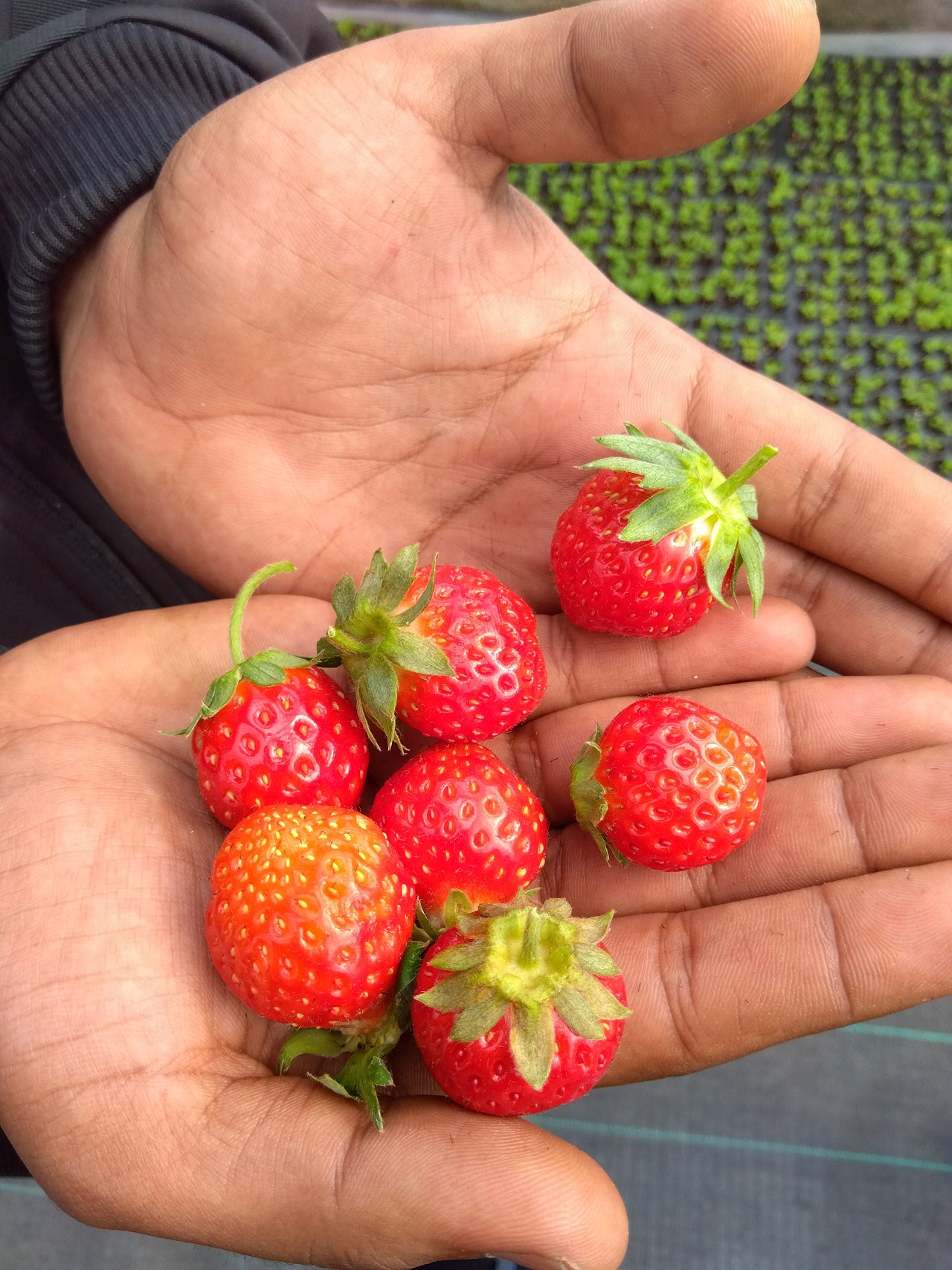
Strip away the towers and the LEDs and the agronomy, and protected, soilless cultivation comes back to one promise that a chef can taste. Fruit grown off the ground, under cover, on a tight water regime arrives cleaner, drier, more uniform and less bruised than fruit dragged out of open soil after a monsoon shower. It is the same goal as the pick window and the cold chain: take every chance, at every step, to put an intact, beautiful berry in front of the person who is going to plate it.
The towers are an experiment. The standard they serve is not.
ICHIGO is a registered Indian trademark of M2labo Pvt. Ltd. Strawberries are grown in India by M2labo Bharat under licence from Miyoshi & Co., Ltd. for the SAKURA and HARUHI Berry Pop F1 cultivars. Photographs are from the Vertigrow polyhouse trial with HiMedia Laboratories. Quantitative claims are drawn from peer-reviewed sources (Journal of Horticultural Science & Biotechnology, 2025; Frontiers in Plant Science, 2025; and Indian polyhouse field trials) and are region- and cultivar-specific; figures for ICHIGO’s own plots are not implied.
Japanese strawberry quality, grown in India's hills.
Notes from the farm, the cold chain and the chefs putting Indian strawberries on the world's tables.