
The bee that shapes the berry: why a lumpy strawberry is a pollination story
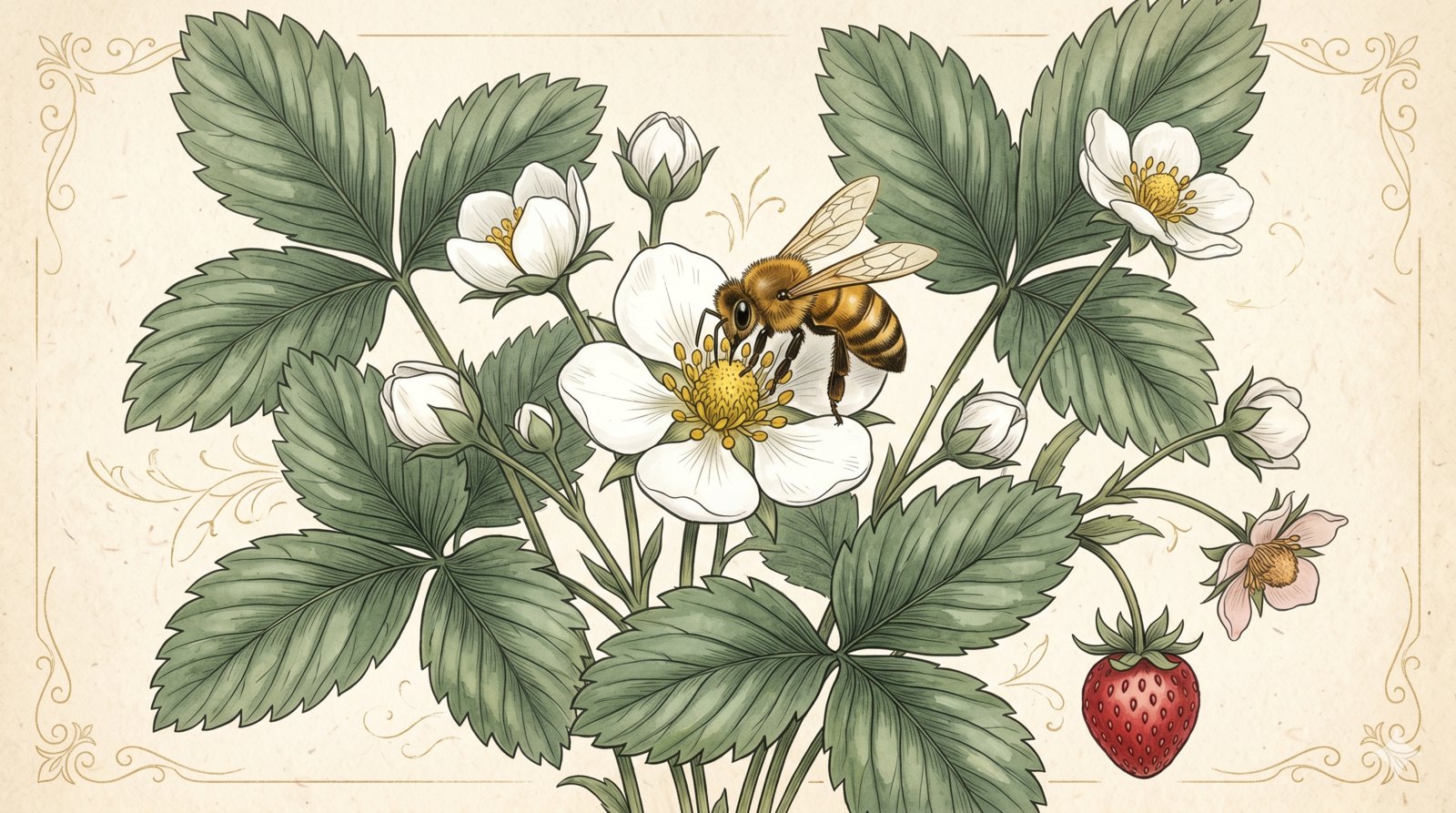
Pick up a misshapen strawberry — lumpy on one side, pinched and seedy on the other — and you are not looking at a sick plant or a bad cultivar. You are looking at an unfinished pollination job. That lumpy berry is a record, written in fruit, of where a bee did and did not visit. To see why, you have to understand a strange fact: a strawberry is not really one fruit. It is hundreds.
A strawberry is a crowd of fruits
Botanically, the strawberry is an aggregate accessory fruit. The sweet red flesh you eat is not the fruit at all — it is a swollen receptacle, the tip of the flower stem. The actual fruits are the tiny things on the surface that everyone calls “seeds.” Each one is an achene, a one-seeded fruit in its own right, and a single strawberry carries anywhere from 20 to 500 of them.
This matters because of how each flower is built. A strawberry blossom holds several hundred separate pistils — several hundred tiny ovaries, each waiting to be fertilised. Every pistil that is fertilised becomes one achene. And here is the mechanism that decides everything: a fertilised achene releases the plant hormone auxin, which tells the patch of receptacle flesh right beneath it to swell. An unfertilised pistil releases nothing, so the flesh around it stays flat.
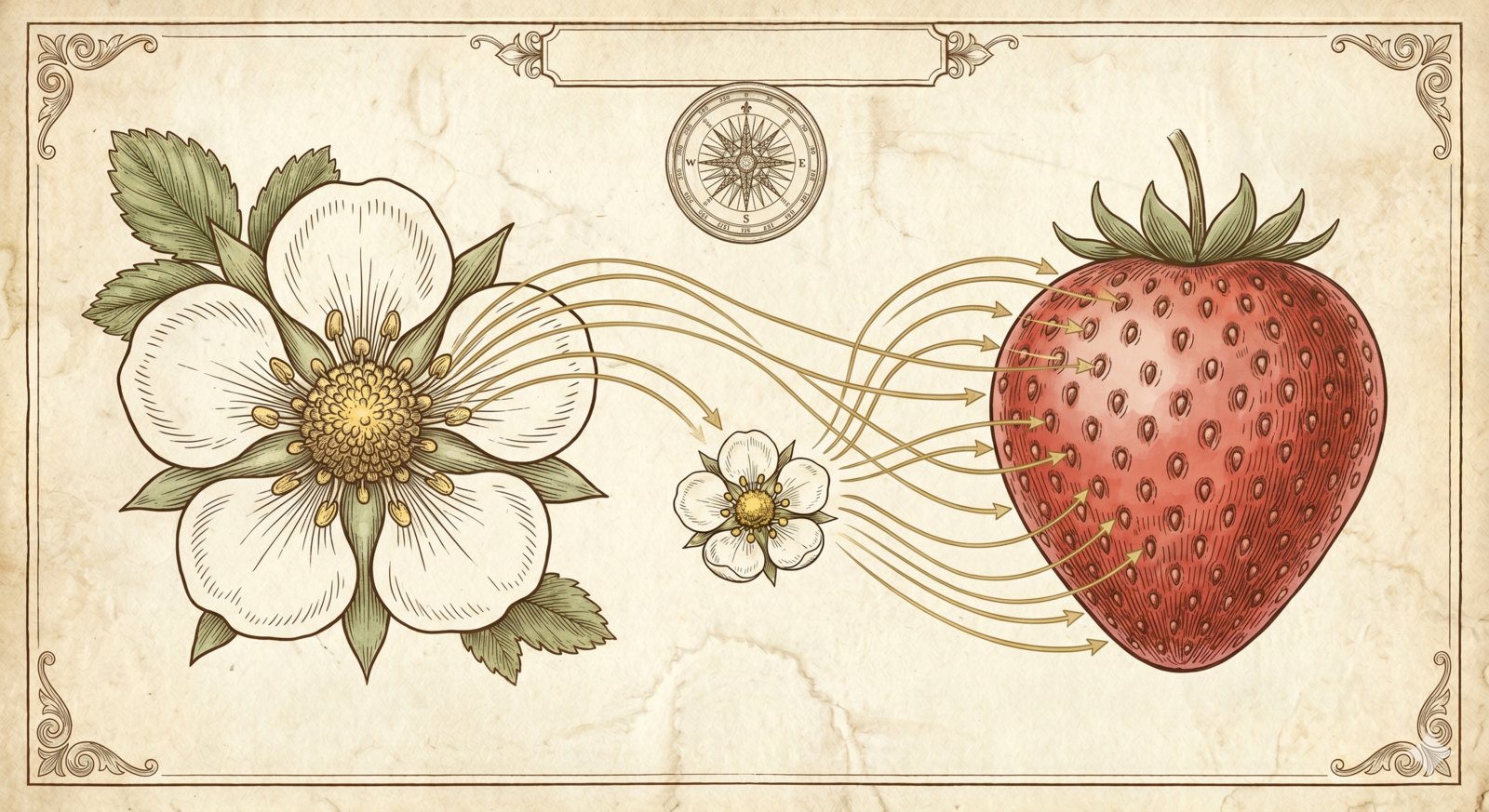
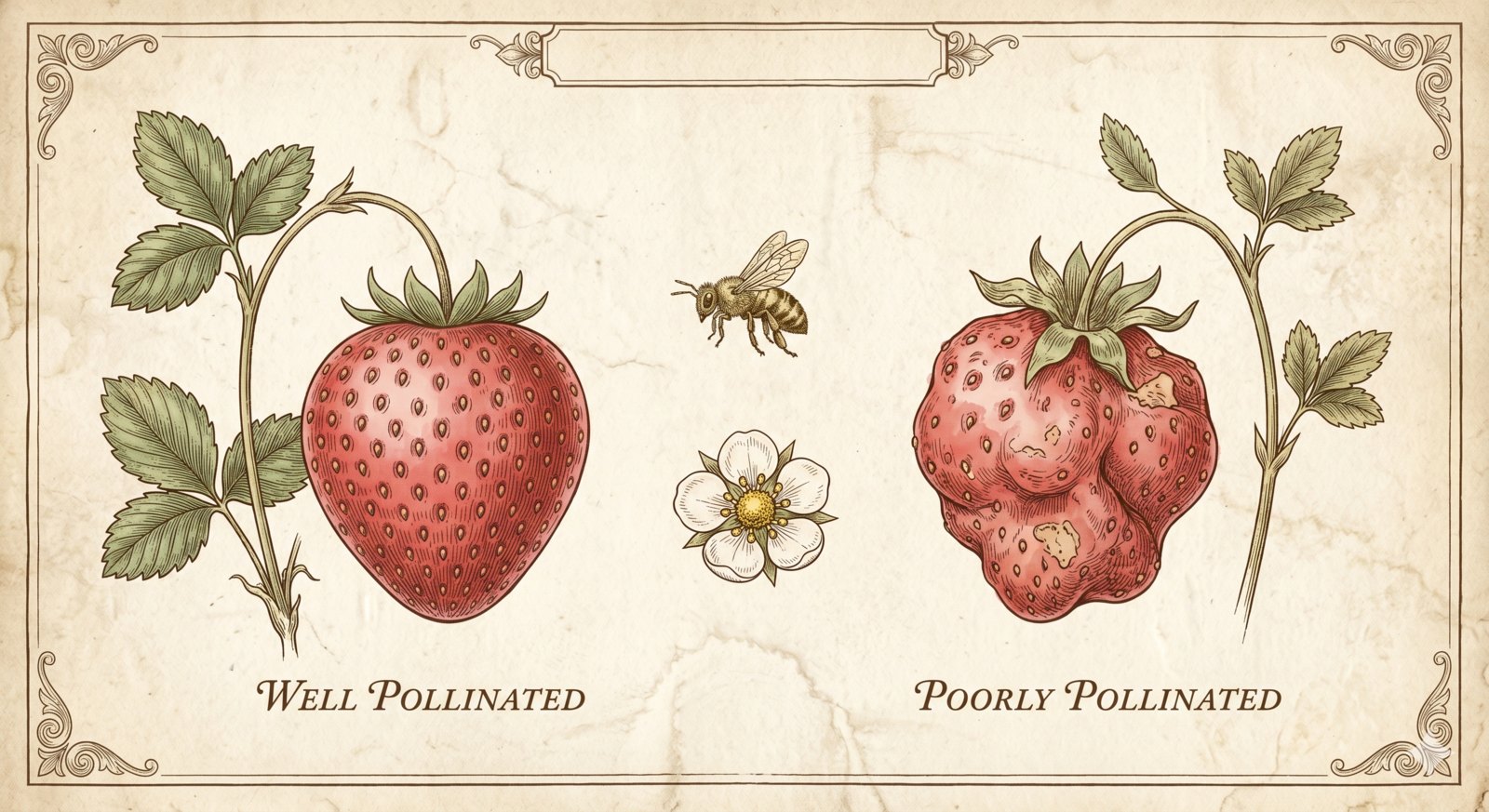
So the shape of a strawberry is, quite literally, a map of its pollination. Fertilise every pistil evenly and the receptacle swells evenly into a smooth, full cone. Miss a patch — because no pollinator carried pollen to those stigmas in the two or three days the flower was open — and that patch simply doesn’t grow. The result is the lump, the pinch, the cat-face. As far back as 1950, the botanist Jacques Nitsch showed the point cleanly: scrape the achenes off a developing strawberry, and the flesh stops growing exactly where you scraped.
Why a bee beats the wind
Strawberry pollen can move a little on its own, and a little on the wind. But the evidence that insects do it far better is overwhelming. Across dozens of studies, fruit from insect-visited plants is markedly heavier, and the incidence of misshapen fruit is more than three times higher on plants kept away from insects. The classic experiments are stark: in one Polish trial, malformed fruit fell from 72% under self-pollination to about 7% under open insect pollination; British and American trials found the same collapse, from roughly half the crop to one in seven.
The landmark study is Klatt and colleagues, published in the Proceedings of the Royal Society B in 2014. Working across nine cultivars, they compared bee-pollinated, wind-pollinated and self-pollinated fruit, and the bee won on every axis that a buyer cares about. Bee-pollinated berries were on average 11% heavier than wind-pollinated and 30% heavier than self-pollinated. They had more fertilised achenes, fewer malformations, more intense red colour, and they were firmer.
That firmness is not a cosmetic detail — it is shelf life. The firmer bee-pollinated fruit lasted measurably longer: after four days in storage, 40% of bee-pollinated berries were still marketable, against 29% of wind-pollinated and none of the self-pollinated. Add it up and the bee-pollinated fruit was worth, by the study’s market grading, around 39% more than wind-pollinated and 54% more than self-pollinated — fruit for fruit. Scaled to the whole European market, the authors estimated that bee pollination contributed 1.44 of the 2.90 billion US dollars of strawberries sold in the EU in 2009. A bee does not just grow more strawberries. It grows better ones, that last longer and sell for more.
The problem with growing under cover
Here is where it gets directly relevant to how premium strawberries are grown today. Protected cultivation — polytunnels, polyhouses, greenhouses — is wonderful for controlling temperature, water and disease. But it does one inconvenient thing: it seals the crop off from the wild pollinators that would otherwise wander in. A flower under plastic, with no insect to visit it, is a flower heading straight for that lumpy, half-swollen fate.
So protected growers have to bring the bees indoors. The two managed workhorses are honeybees (Apis mellifera and the Asian Apis cerana) and bumblebees (Bombus terrestris and kin); hives are placed right inside the structure. Which is better for strawberry is genuinely unsettled — the research is mixed, with honeybees ahead in some trials and bumblebees in others. But the need is not in doubt. One 2023 greenhouse simulation found strawberry yield and quality climbing with bee density and then levelling off at roughly one honeybee per plant — a useful rule of thumb for stocking a house. Japanese forcing houses, which grow premium cultivars through the winter under cover, have long treated an introduced honeybee colony as standard equipment, not an optional extra.
For a grower like ICHIGO, working Japanese cultivars under protected conditions, this puts pollination in the same category as the choice of seed and the discipline of the cold chain: a deliberate quality input, not something left to luck.
The other half of the bargain
Bees build the berry; other animals are meant to move it. The strawberry is red, soft and sweet for a reason that has nothing to do with us — it is an evolutionary advertisement aimed at birds and small mammals, which eat the flesh and carry the hard little achenes away to germinate elsewhere. The same surface seeds that a bee’s work plumps up are, in the wild plant, a dispersal strategy. (The flip side, for a grower, is that birds and slugs would happily collect that reward before any human does — which is one more reason premium fruit is grown under cover and picked on a tight window.)
What you’re really holding
Next time you see a flawless ICHIGO berry — even shoulders, a full deep-red cone, seeds evenly spaced from calyx to tip — read it for what it is. That evenness is not just the cultivar, though the cultivar matters. It is the signature of a flower that was visited thoroughly, every stigma dusted, every achene set, every patch of flesh told to swell. The shape is a pollination record. Behind a beautiful strawberry, there is almost always a busy bee.
ICHIGO is a registered Indian trademark of M2labo Pvt. Ltd. Strawberries are grown in India by M2labo Bharat under licence from Miyoshi & Co., Ltd. for the SAKURA and HARUHI Berry Pop F1 cultivars. Scientific claims in this article are drawn from peer-reviewed sources (Proceedings of the Royal Society B; Agriculture, Ecosystems & Environment; Frontiers in Plant Science; and the foundational work of Nitsch, 1950). Quantitative figures are from European-cultivar studies and are cited as such.
Japanese strawberry quality, grown in India's hills.
Notes from the farm, the cold chain and the chefs putting Indian strawberries on the world's tables.