
The strawberry's 300-year journey: from a Chilean shipment to a Japanese greenhouse
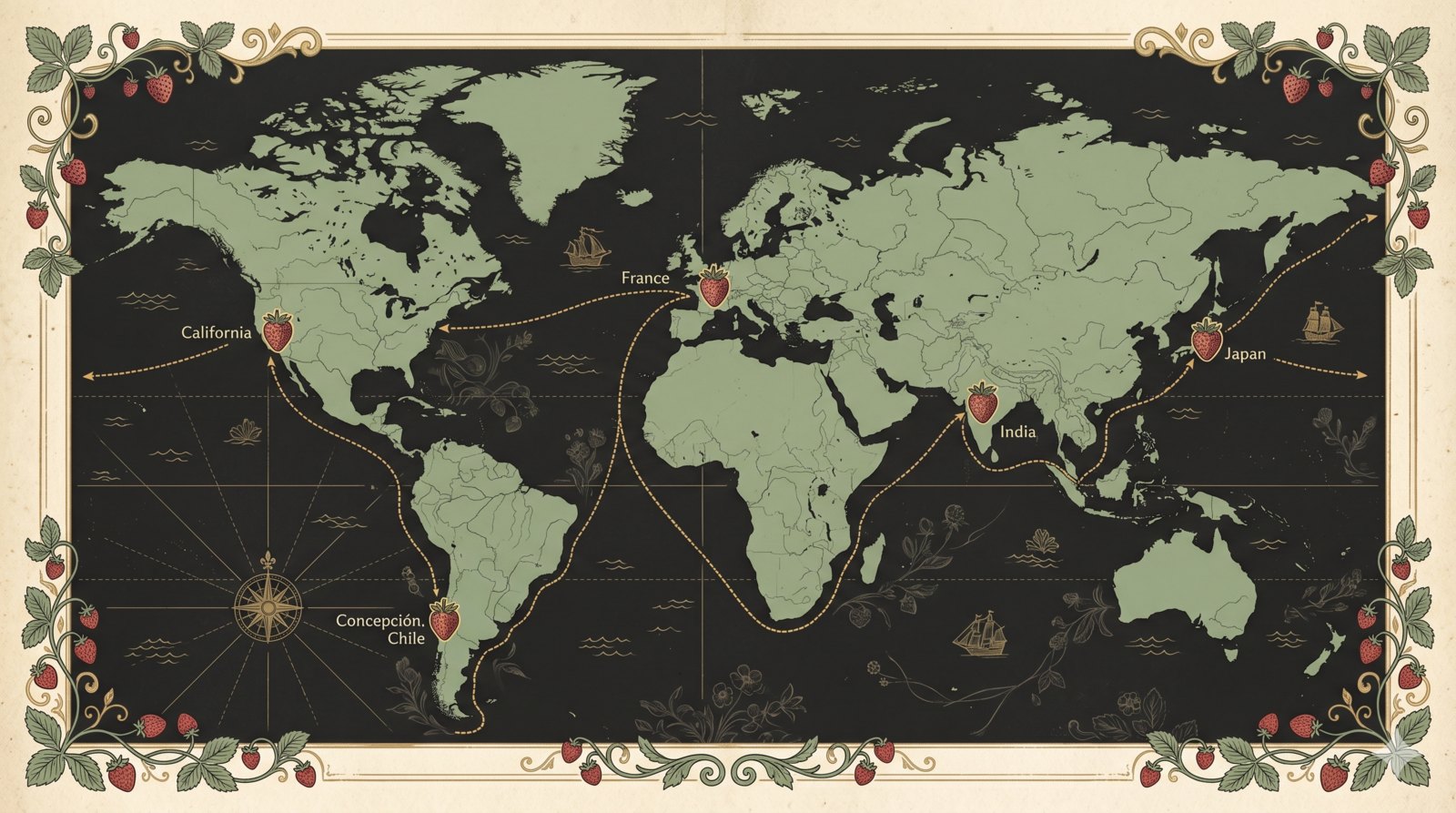
Here is a fact that surprises most people: the strawberry on your plate is one of the youngest crops humans grow. Wheat is ten thousand years old. The apple, several thousand. The modern garden strawberry — Fragaria × ananassa — is less than three hundred years old, and we can name the decade it was born.
It is also one of the few major fruits whose entire family tree is documented. This is the story of how a wild Chilean plant and a wild North American plant met in a French garden, and how the cultivar in your punnet got there.
A plant smuggled out of Chile
In 1714, a French military engineer named Amédée-François Frézier returned from a survey mission on the Pacific coast of South America. Among his cargo were a handful of strawberry plants he had collected at Concepción, in what is now Chile — a species the indigenous Mapuche had cultivated for centuries, Fragaria chiloensis. Of the plants he carried across the Atlantic on a months-long voyage, roughly five survived.
Those five plants were a problem. F. chiloensis produced large fruit, but the plants Frézier brought back were almost all female — they flowered but rarely set fruit on their own. For decades they sat in French and English gardens as a curiosity.
The answer was already growing nearby. A second wild species, Fragaria virginiana from the eastern woodlands of North America, had reached Europe earlier. It was smaller-fruited but aromatic and a reliable pollinator. When the two were planted near each other, they crossed — and the offspring combined the size of the Chilean parent with the flavour and fertility of the North American one.
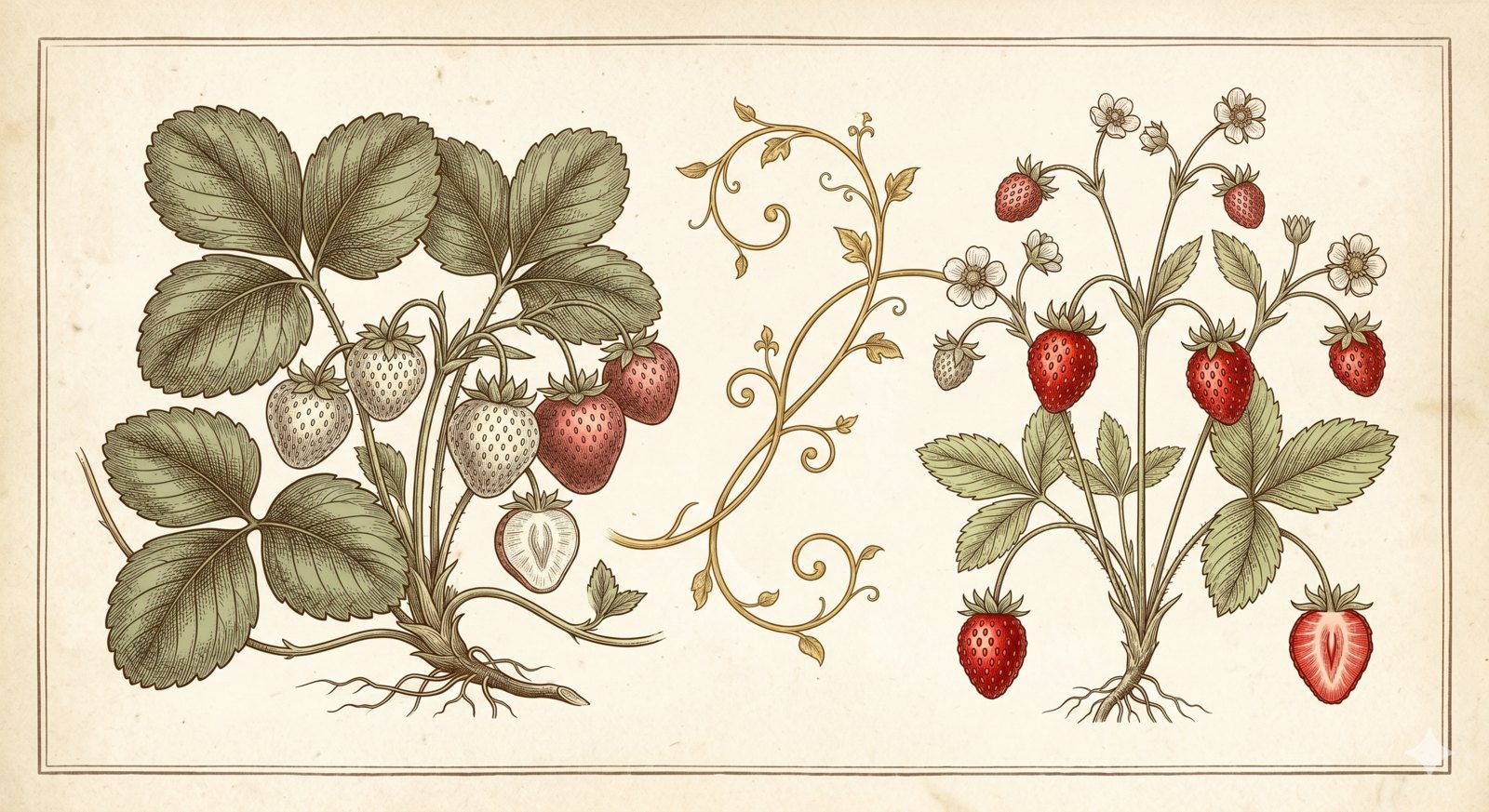
Both species are octoploid — they carry eight sets of chromosomes (2n = 8x = 56), unusual in the plant world — which is part of why their hybrid was so vigorous. The cross happened around the 1750s in Europe, with Brittany, France, usually named as the cradle. In 1766, the French botanist Antoine Nicolas Duchesne documented the new hybrid in his Histoire naturelle des fraisiers, formally describing the plant we now call Fragaria × ananassa — the ananassa meaning “pineapple-like,” for its scent.
Every commercial strawberry grown today, from California to Maharashtra to Tochigi, descends from that accidental French cross. The fruit is a New World plant, assembled in the Old World, and perfected — as we’ll see — partly in Japan.
How a wild fruit became an industry: the cultivars
A species is not a strawberry you can sell. The fruit you actually buy is a cultivar — a specific bred variety, propagated to be identical plant to plant. Three breeding traditions shaped the modern market.
California: the workhorses
No institution has shaped the global strawberry more than the University of California, Davis. Its breeding program produced the cultivars that fill supermarket shelves across the world:
- Chandler (released 1983) — the variety that defined the modern fresh-market berry for a generation.
- Camarosa (released 1992; U.S. plant patent PP8708 granted 1994) — bred by Victor Voth, Douglas Shaw and Royce Bringhurst from a 1988 cross, it became one of the most widely planted strawberries on Earth, prized for yield, firmness and shipping tolerance.
- Albion (released 2004) — a day-neutral variety, meaning it fruits regardless of day length, extending the season dramatically.
These are engineering triumphs. They are bred to yield heavily, ship far, and survive handling. What they are not bred for, primarily, is perfume.
Florida: early and sweet
The University of Florida program optimised for a different climate and a different calendar:
- Sweet Charlie (released 1992) — a low-acid cultivar that tastes sweeter than its sugar reading suggests. Its fruit is soft, which ended its large-scale commercial life; today it survives as a favourite for U-pick farms.
- Winter Dawn (released 2005) — known for remarkably early yields, but with modest flavour and fruit that shrinks as the season runs on.
If you have eaten an Indian strawberry, you have almost certainly eaten one of these three families — Sweet Charlie, Winter Dawn, or Camarosa. They were adopted across India after 2000 because they tolerate the climate and yield reliably. They are good workhorses. They were simply never bred for the dessert counter.
Japan: bred for the plate, not the truck
Japan took the same New World hybrid and asked an entirely different question. Where California optimised for shipping and yield, Japanese breeding optimised for eating — sugar-to-acid balance, aroma, firmness that holds a clean knife cut, and even ripening.
This required a different growing system. Over 90–95% of Japan’s strawberry acreage uses forcing culture: plants grown under polyethylene tunnels and coaxed to fruit from late autumn through to early summer, well outside the natural season. The technique that made this possible was developed in the late 1960s — a combination of starving nursery plants of nitrogen, raising them under long-day light in walk-in tunnels, and applying gibberellic acid before the plants went dormant, so flowering could be advanced to late summer.
The result is the lineup that defines Japanese strawberries: Tochiotome, Saga-honoka, Amaou, Benihoppe — cultivars bred region by region, each tuned for flavour first. These are the berries that perfume a Tokyo department-store basement ten metres before you reach the counter.
The newest chapter: strawberries from seed
For its entire 300-year history, the cultivated strawberry has been propagated the same way — vegetatively, by cloning runners (stolons) off mother plants. It is slow, labour-intensive, and a vector for disease.
In March 2021, the Tokyo breeding house Miyoshi & Co., Ltd. announced something new: the world’s first private F1 seed-propagated Japanese strawberries, branded the Berry Pop series. Instead of cloning runners, growers sow seed — which, in Japanese conditions, cuts the seedling-raising period from about six months to about three, and eliminates the mother-plant nursery and the disease risk that comes with it.
The first generation comprises two cultivars:
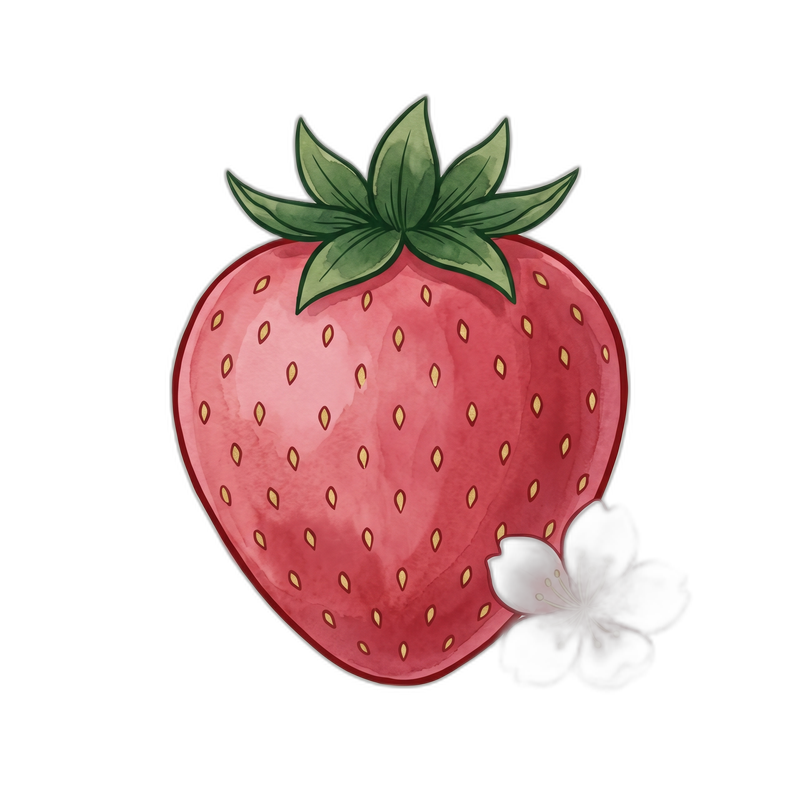
- Berry Pop SAKURA (variety code 19FAG-1) — a short-day type, producing many medium-sized fruits, with high sugar and moderate acidity for a refreshing flavour. Miyoshi’s own specification puts its average sweetness at 12.4 Brix.
- Berry Pop HARUHI (variety code 19FAG-2) — a short-day type producing larger, stable conical fruit, rated by the breeder at 12.6 Brix.
(Brix figures here are Miyoshi’s stated specifications from its own comparative trials; the actual sugar reading of any berry depends on how it’s grown, the season, and ripeness at picking.)
Where ICHIGO fits
This is the lineage ICHIGO joins. ICHIGO grows SAKURA and HARUHI — Miyoshi’s Berry Pop F1 cultivars — in Indian fields in Maharashtra, under Japanese agricultural supervision, rather than airfreighting finished berries from Japan.
The logic follows directly from the history above. The genetics that make a Japanese strawberry worth eating are portable — they live in the seed. What doesn’t travel well is the finished fruit, which loses sugar, scent and firmness within hours of picking. So the right move isn’t to import the berry; it’s to import the cultivar and the discipline, and grow it close to the kitchens that will use it.
Three hundred years ago it took a months-long sea voyage and five surviving plants to move a strawberry across the world. Today it takes a seed packet and a breeding licence — and the journey ends not in a French garden, but in an Indian field.
ICHIGO is a registered Indian trademark of M2labo Pvt. Ltd. Strawberries are grown in India by M2labo Bharat under licence from Miyoshi & Co., Ltd. for the SAKURA and HARUHI Berry Pop F1 cultivars. Historical and botanical facts in this article are drawn from peer-reviewed sources (American Journal of Botany; The Plant Cell; International Journal of Fruit Science), U.S. plant-patent records, and the breeders’ own published specifications.
Cooking with ICHIGO?
See the current grades, crate prices and next Vegibus delivery slot for your city.