
The robot that can't quite pick a strawberry — yet
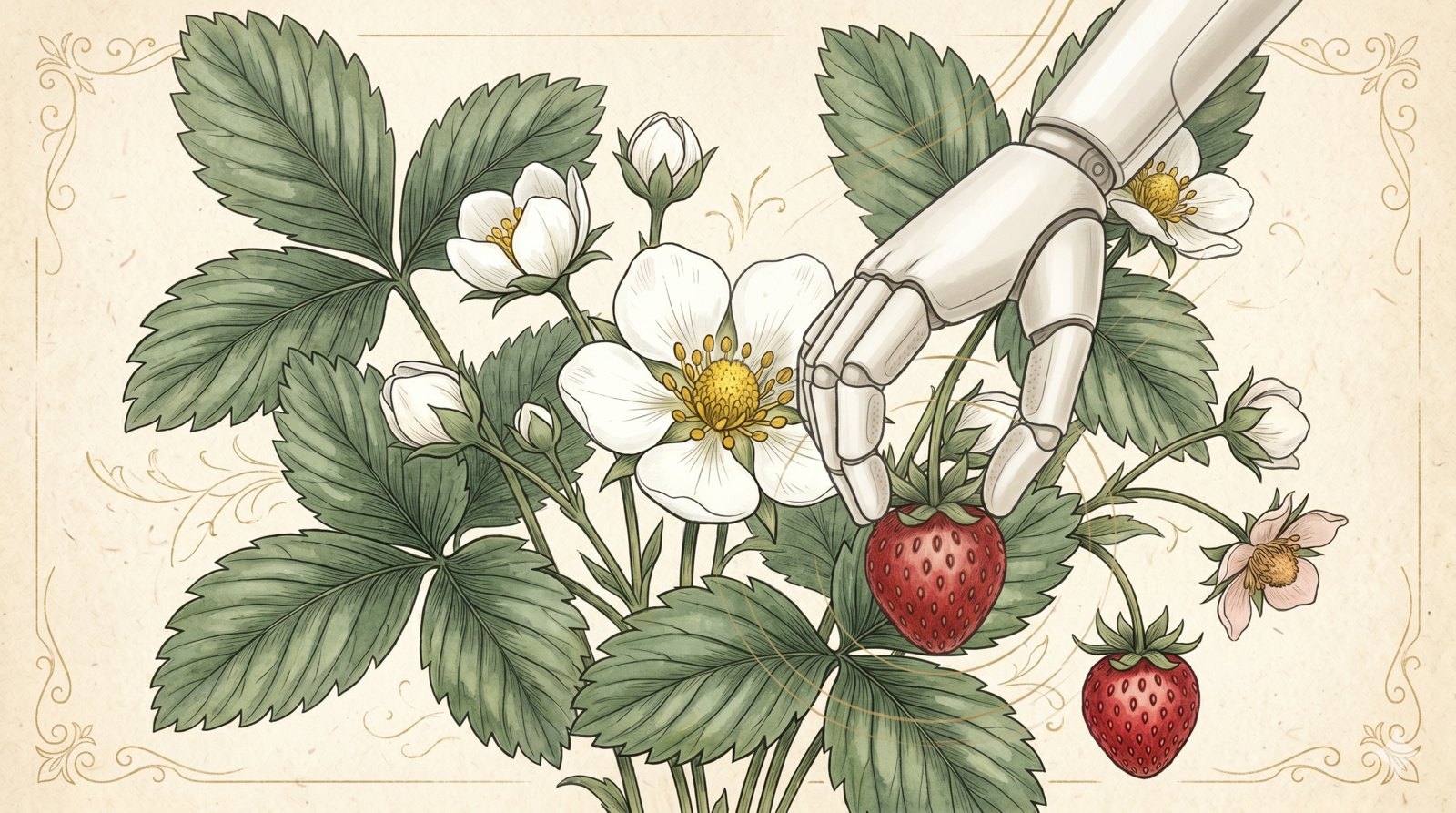
A strawberry is one of the hardest things in agriculture to teach a robot to pick. Not because a machine can’t be gentle enough — the best grippers now cradle a berry without bruising it. The hard part is a deceptively simple decision: find the one ripe berry, hidden under a leaf, growing in a cluster beside three unripe siblings, and judge in real time whether this one is ready. A human picker does it in five or six seconds without conscious thought. The best research robots take around twenty, and still leave roughly a quarter of the ripe fruit on the plant.
This is a story about why the strawberry resists automation — and what that resistance tells you about what actually goes into a good punnet.
The reason the robots are coming
The pressure to automate is economic, and it is enormous. Hand-harvesting is the single largest cost in growing strawberries. In California it runs to 50–60% of variable production cost. University of California, Davis’s 2024 Central Coast cost study puts harvest and post-harvest at roughly 70% of total cost — about $79,000 of every $112,000 spent per acre — with the hand pick-sort-pack line alone costing some $61,000 per acre. A picker harvests three to eight trays an hour, by hand, berry by berry.
At the same time, that labour is getting harder to find and pay for. The inflation-adjusted hourly earnings of U.S. field workers rose 16% between 2001 and 2019, while non-agricultural wages rose just 5% — a sign of tightening farm-labour markets. When the most expensive, most labour-intensive step in your business is also the one getting scarcer, the incentive to build a machine for it is obvious.
So why isn’t it done?
Why a strawberry is so hard
The U.S. Department of Agriculture places strawberries at the hard-to-mechanize end of the spectrum — among the crops for which “few or no viable harvest machines are available,” alongside fresh tomatoes and iceberg lettuce. Three things make the berry uniquely stubborn:
- It hides. Field strawberries grow under their own foliage, not dangling in the open like the tabletop test plants robots were first trained on. The robot often can’t even see the fruit.
- It clusters. Ripe and unripe berries grow tangled together. Separating one without disturbing the others defeats both the camera and the gripper.
- It’s fragile and never stops ripening. The fruit bruises at a touch, and a field has ripe, half-ripe and green berries on the same plant on the same day — so the robot has to choose, not just harvest.
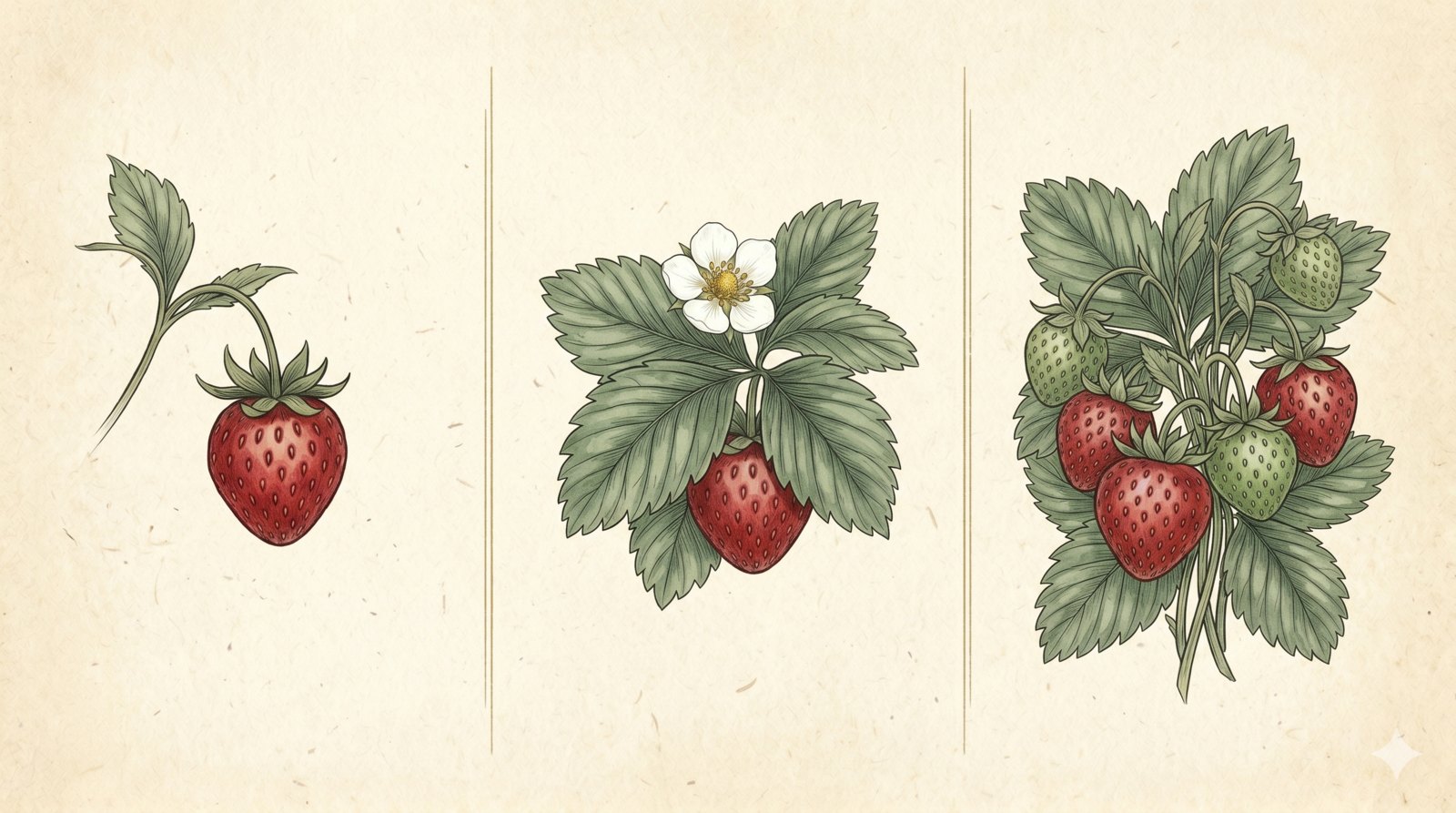
The canonical illustration comes from a 2020 study by Xiong and colleagues (NMBU / Saga Robotics, Norway and the UK), published in the Journal of Field Robotics. Their robot picked isolated strawberries with a near-perfect 96.8% success rate. In real farm conditions, that collapsed to 53.6%. Most of the failures? Berries growing in clusters — exactly the case the lab demo had skipped.
How a robot sees and grips a berry
Closing that gap is where the interesting engineering lives.
Seeing. Modern pickers run deep-learning vision — object detectors with names like YOLO, Faster R-CNN and Mask R-CNN — to spot berries and grade their ripeness by colour and size. One Japanese research system (Fujinaga) combined fruit-picking with stem pruning, hitting detection F1 scores of 0.96 for ripe and 0.88 for unripe fruit. To locate a berry in space, robots add a 3D camera that captures colour and depth together, so the arm knows not just where on the image the berry is, but how far away.
Parting the leaves. A Washington State University team (Zixuan He, Manoj Karkee, Qin Zhang), publishing in 2025, tackled the hiding problem with a clever trick: a fan. Their robot was the first to clear obscuring foliage at field scale with a puff of air rather than mechanically pushing leaves aside. The effect is measurable — and humbling. Without the fan, the robot picked 58% of the ripe fruit; with it, 74%. A genuine gain, and still a quarter of the crop left behind.
Gripping without bruising. In March 2026, Cornell’s Organic Robotics Lab (Rob Shepherd, Anand Mishra) published a soft five-finger gripper in Nature Communications that fuses touch and vision: thirteen sensors, including stretchable optical fibres that feel an object’s firmness. Crucially, instead of pulling the berry — which bruises it — the gripper grasps and then twists it off the vine via a small geared wrist, the way a human hand does. The earlier Xiong gripper took a different route, opening its fingers to “swallow” the target berry and nudge its neighbours aside.
Where it actually stands in 2026
Here is the honest picture, because the marketing can get ahead of the reality.
The most advanced commercial effort is Harvest CROO Robotics of Tampa, Florida (founded 2013), whose machine runs sixteen picking robots in parallel. In April 2025 the company announced its field trials had demonstrated “commercial viability” at rates “on par with human harvesting.” That sounds like the finish line — but read it carefully. It was a vendor announcement with no independent verification, describing a field trial, not a fleet-scale rollout, on a farm whose owner is also a company co-founder. The stated near-term goal was to run three machines at the start of the next season.
The systems with the strongest evidence — the WSU and Cornell robots — are explicitly research prototypes, not products. And they are slow: around 20 seconds per berry, against a human’s five or six. No one, anywhere, has a robot replacing strawberry pickers at scale. The strawberry has not been solved.
What this means for ICHIGO
Look closely at what the robot is straining to do: examine this berry, under this leaf, and decide whether it is ready. That judgement — not the gripping, not the moving, but the deciding — is exactly what ICHIGO trains its pickers to make.
As we wrote in our first Journal piece, the single biggest determinant of how a strawberry tastes at the customer is the colour it was when it left the plant. The ICHIGO pick window — deep red, still firm, a day or two before the usual Indian convention — is a decision made by a trained human eye thousands of times a day. It is the same decision a $500,000 robot still gets wrong a quarter of the time.
When the machines are genuinely ready, we will use them, for the right reasons: consistency, and relief from a labour bottleneck the whole industry feels. But a robot that picks the wrong berry quickly is worse than a trained picker who picks the right berry. For premium fruit, today and for some years yet, the decisive instrument is still the human eye.
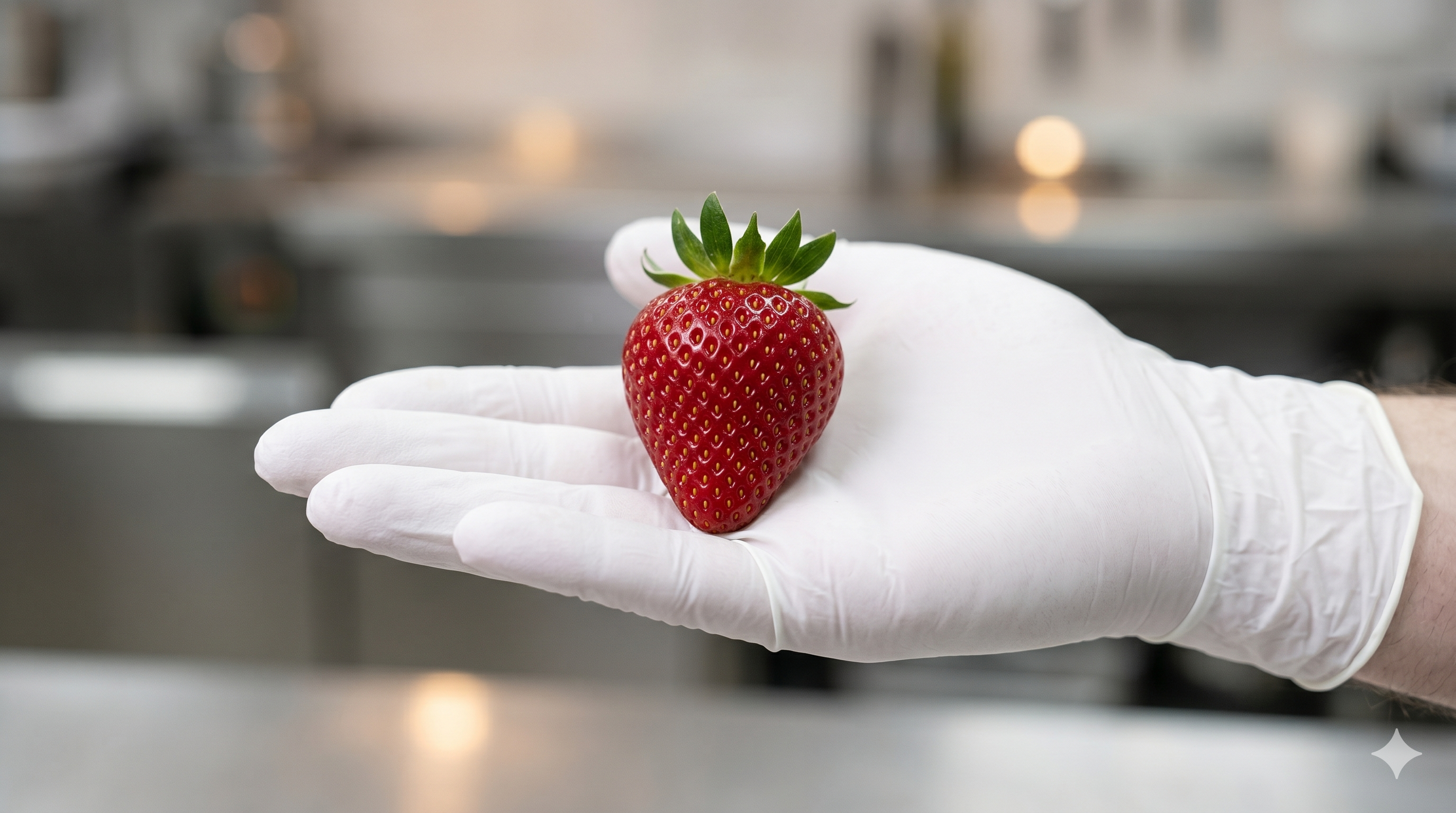
Three hundred years of breeding put the genetics into the seed. The last six inches — hand to calyx, in the half-second of judging “this one” — is still ours.
ICHIGO is a registered Indian trademark of M2labo Pvt. Ltd. Strawberries are grown in India by M2labo Bharat under licence from Miyoshi & Co., Ltd. for the SAKURA and HARUHI Berry Pop F1 cultivars. Technical claims in this article are drawn from peer-reviewed sources (Journal of Field Robotics; Computers and Electronics in Agriculture; Nature Communications), USDA and UC Davis economic studies, and company disclosures; vendor performance claims are identified as such.
Cooking with ICHIGO?
See the current grades, crate prices and next Vegibus delivery slot for your city.